
How to Use a CRM Effectively: Salesforce Strategies for Better ROI
By Deb Andrews
Originally Published
One of the common mistakes for growth-minded companies is investing in technologies before understanding how they will help them achieve organizational goals. We see this often with Customer Relationship Management (CRM) tools in particular. To help us better understand why, we spoke with our friend and colleague Bilal Muta, a CRM consultant. Our discussion revolved around the Salesforce CRM platform and how organizations can better leverage it to improve their profitability and efficiency through data and insights. Now while Salesforce might not be for everyone given its price point, if you’re interested in the strategy, guidance, and methodology behind setting up such a system, this is a valuable read.
Q: For companies that go with Salesforce, what do they hope to achieve?
A: For many companies, they know of Salesforce and its robust feature set, and they want to leverage the data insights to be able to get a better return on investment. They want more leads, money, sales, and they want it faster and more efficiently. They think when they get Salesforce, they’ll make more money. The customers that come at Salesforce from a marketing lens, they look for more understanding of the sales activities, what customers are going through, and how that relationship is being developed through the sales process. Ultimately they’re after more and better leads to drive business for the organization.
Q: What percent of businesses realize the described high-level benefits?
A: Of my 75 implementations and many other optimization projects, I’d guess 25% truly tap into the capabilities of what the platform can do for their business. They really understand what it does and integrate it throughout their business processes. About 50% use it and apply some best practices. If you asked them, they’d say something like, “Salesforce is working here, but we haven’t changed over there.” Or, “It’s helping us with leads but not opportunities.” There’s usually some big missing piece that’s holding them back from accomplishing their goals. The last 25% imagine it as a magic wand. They think it’ll be easy, they’ll buy it, and tomorrow their business will transform. They don’t realize Salesforce is a tool, and it’s not going to make money just flow in. They need to invest time and resources into their business processes to truly tap into the platform’s capabilities. The optimization projects that I work on typically involve clients that have had Salesforce for a year or more. They use the system and have some processes built in, or they use it for logging sales activities. When you look at the day-to-day however, most of what they’re doing lives outside of the system, so they’re not able to leverage the power of Salesforce. They can’t learn about and optimize what they do. A quarter of my time in those projects goes to Salesforce—adding fields, creating automations—and the rest of the time is about helping them document, understand, and refine their processes.
Q: Why do companies fail when using Salesforce?
A: Businesses are always trying to move quickly toward their goals. So they buy the platform, speed through the launch process in two weeks, and pat themselves on the backs when people are able to log in. They need to take a step back and think about how they will accomplish their vision. If they want it to really work, they should consider it like building a house—it’s about adding one brick at a time. They’re building a strong foundation to help them scale their business.
That leads right back to business processes. Some clients will detail a concrete sales process that really makes sense to me, where they’re guiding a lead through their products in something like seven stages. Then I’ll go into their system and only see four stages, no leads, and no places to input and output the different processes required by that sales process. I’ll ask, “How do you make sure people are accountable for this sales process?” And they won’t have a clue. What I’ll slowly uncover through interviews with the sales team is, although the CEO claims there’s one sales process that everyone follows, each salesperson has his or her own approach to get to the end goal. That’s a real issue. You can’t scale a system if there’s no measure of consistency across the entire team.
Q: We’re trying to gain traction with a client’s sales team to have them attribute sources to leads in Salesforce, so we can track what marketing tactics are working. But we get a lot of pushback from the sales team. The argument is that they don’t have the time, because they’re out on the road, banging on doors, and dealing with full email inboxes. What do you say to the busy salesperson that isn’t taking the time to help marketing extract meaningful data? Isn’t that one of the biggest goals?
A: I was just talking with a client about this. I had another client in food services, who was talking about coaching his new line cooks on the omelet station. He has seven cooks making made-to-order omelets, and some of them get frazzled when it gets busy. He tells them to take a step back and take 30 seconds. “I don’t have time,” they’ll say. “You’re breaking more eggs because you don’t have time,” he’ll reply. “Take a step back for 30 seconds, and you’ll make up the time.” You’ll have more time if you take a step back, get your breath, gather your thoughts, understand what you’re trying to do, then make the omelet. Him taking that step back will help him get control and handle the rush. I bring up that analogy a lot now. Maybe if your sales rep takes a step back, he won’t visit five accounts. Maybe he’ll only visit three, but that focus will really pay off. What would you rather pay mileage on? What would you rather see ROI on?
But the real opportunity is building consistency. A consistent, documented, trackable sales process. A process that works for the business and customers. That’s the hardest thing to do, because it requires understanding the business as a whole. Taking that step back feels like a waste of time, but we end up gaining so much time by doing it. And they really start to see the ROI on their investments, whether they’re Salesforce, HubSpot, or any other optimization platform.
Q: Do you have to give timing to set expectations in terms of when they’ll see the benefits of Salesforce?
A: I base it on the organizations’ sales cycles. If it’s a short cycle, under a month, they typically see gains within three to six months. That gives enough time to see customers go through a few cycles. They’ll have leads coming in. They’ll see quicker closes, and more real-time feedback from customers. They’ll even start to see where they’re wasting time on customers who might not be ready to buy, which gives marketing some insight on how to better nurture and get those leads ready for sales when the time is right. If it’s a long sales cycle, they won’t see the return on their bottom line right away. For capital expenses, there’s a two- to three-year sales process. Realistically, they won’t see a bottom-line return for a number of years. They see the return in different ways. For example, they’ll gain a much better understanding of where their customers are in the cycle, and where they need to stop spinning their wheels. By building out those processes in Salesforce, they’re not flying blind. They can really understand where and how they’re spending their time. And they can think about where they should be spending their time today versus tomorrow, so they can really drive customers to close. It’s a challenge, but Salesforce is really going to give them the insights they need to be able to make better decisions. Sales, marketing, and customer service teams can benefit from it.
Q: What can executives do to drive better adoption today?
A: First, stop talking about quotas. This happens especially when executives come from a sales background. A lot of those leaders will mention a sales rep who doesn’t log into Salesforce, doesn’t follow the process, goes rogue every waking moment. And that’s their best rep. He sells more than anyone and brings in more business than anyone else. They need to stop rewarding folks who are just hitting quota. They need to focus on steps that they can control, like activities. An activity-based selling system is what’s going to drive acquisition, new business, and closing new deals. It’s the same on the customer-service side; those activities matter. How responsive are you? How real-time are you? Those are the metrics to focus on.
The next thing I would say is for leaders to think about what they expect sales reps to do to drive new business. Maybe they expect sales reps to make five calls or send five emails per day. Maybe it’s a set number of customer meetings. I worked for a company that used to sell space in a data center. One of the metrics we started to track as an organization was data center visits. When prospects saw the center, they got a feel for it, they had a conversation, and so on. So driving and rewarding reps—with financial incentives, accolades, or pats on the back—that’s what pushed the right type of activity. With the right type of activity, the sales take care of themselves.
Q: When shifting from quotas, what metrics have you seen work for teams in these scenarios?
A: I think they should focus on the things that lead them to their goals—not the goals themselves. For example, they can’t meet with prospects without scheduling appointments, and they can’t schedule appointments without prospecting. So a common and important KPI would be around prospecting activities. We’d then measure prospecting activities for the day, week, and month. How many outbound prospecting phone calls? Outbound emails? If lead generation is a goal for reps, how many networking events and trade shows do they attend daily or weekly? It’s critical to narrow the focus on what’s important, the key measurable things that lead to success in your business. This focus can be applied to ensure sales and marketing are both doing the right things for each other and the organization. For example, you might want to track defined lead sources or campaigns, specifically when a rep inputs a Sales Generated Lead into Salesforce. (I’m a big fan of campaigns and think they’re heavily underutilized.) Or maybe you track how long it takes sales to follow up and update the status of Marketing Generated Leads, so you can ensure timely followup and real-time communication about leads. Of course, you’ll need a defined lead process with stages, so sales reps can update statuses accordingly. It’s not just a sales thing though. Marketing can work to define clear criteria for inputting campaigns and lead sources. They can focus on better understanding the stages of their buyer’s journey to improve when they hand leads over to sales. They can communicate these things through dashboards and fields in Salesforce.
Q: How can we create better alignment between marketing and sales?
A: I think marketing and sales need to go to relationship counseling. It’s a relationship. They both bring something to the relationship, and they both expect different things. So they need to understand each other, so they can work together and be more effective at what they do together.
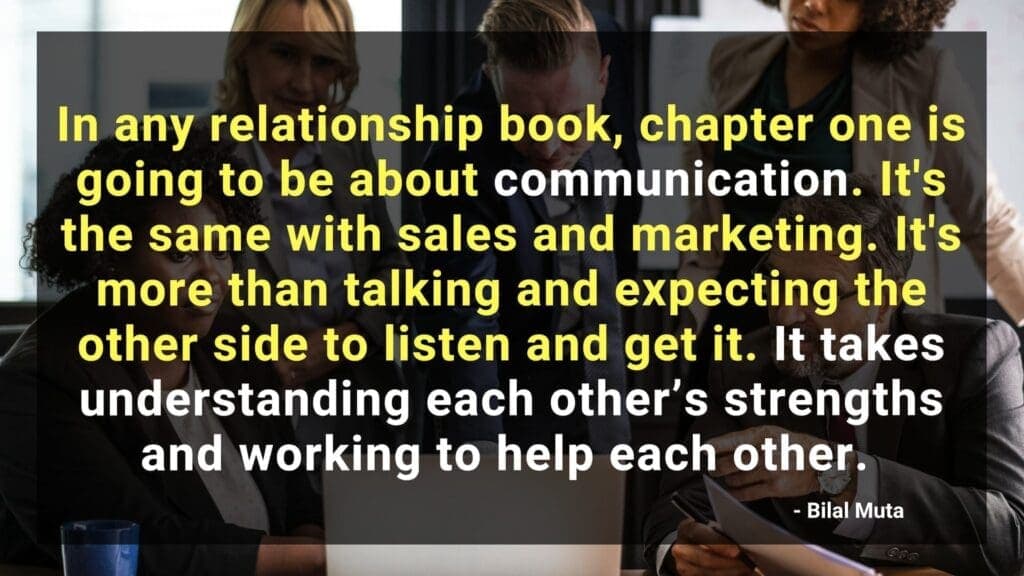
Marketing is going to be instrumental at the top of the revenue funnel, specifically working on activities with potential leads who could turn into prospects. They can communicate the value proposition of the company, or help leads better understand their own needs. Then when those leads are passed to sales, they’re much more qualified and ready. And the sales rep doesn’t have to spend hours, days, or weeks trying to work that lead to the point of readiness. When I work in that relationship and alignment space, the returns are almost immediate. Sales loves it. They have leads that are more ready to go, and when they call these leads, those leads are expecting the call and pick up. But it’s important that sales understands that marketing isn’t a binary driving the bottom-line or wasting their time. They can really help marketing by being consistent about the process they agreed to follow. By just using the system in a consistent way, they inform marketing in terms of where they can improve. Where can we optimize? What’s working? What can we automate? Marketing can even help with hurdles down the funnel if it addresses sales challenges sooner in the marketing cycle. For example, they can set the stage for pricing, so it isn’t such a surprise later on. No one complains about $1000 iPhone or Galaxy, because people understand the value. The marketing effort helps customers justify that expense, and it takes the load off sales. It’s a matter of building marketing materials that resonate, applying content marketing for growth concepts in the real-world funnel. If you really want to make the relationship official between marketing and sales, I’m a big believer in Service Level Agreements (SLAs). Those agreements can happen between departments, almost like vows. Marketing, what do you promise to deliver? Sales, what do you promise to do?
Q: In terms of alignment, the SLA is a great idea, but then how do you translate that into Salesforce action?
A: Many of my customers write one- to two-page SLAs. They never work on it in silos. It’s typically the head of marketing and the head of sales sitting in a room together and writing it down. If it’s not a department head or executive, then we bring the entire organization in. There’s something different about putting it on paper. Having the agreement on paper, and then having people put their signatures on it, that’s a different level of commitment. It’s really powerful for the organization, sets the tone for the communication moving forward, and puts them on a path to being a real revenue team. Starting off with an SLA can really help toxic sales and marketing relationships push past that toxicity and transform them into productive relationships.
Q: What resources are recommended for companies that have made a big financial commitment to Salesforce, but have not seen the payoff and are thinking about dropping it?
A: Call us. We’ll fix it. Just kidding. But the real thing to understand is there is no magic wand. I wouldn’t be doing this if it was a matter of setting up one system and calling it a day. It’s usually not just a matter of switching CRMs. Or moving from one marketing automation platform to another. It’s often not even a matter of features, user interface, or those types of touches. The secret sauce is what a company puts into the tool. Before they bail out on their investment, I recommend that a company that has never seen a payoff bring in an expert to understand why that return isn’t happening. In terms of my own experience, I can count on one hand where it came down to Salesforce not being the right tool for the customer. More times than not, the return comes down to business process problems. If they jump ship, they’re going to bring those problems with them into the new system. And that system won’t work either.
Want to learn more about marketing and sales alignment?
If you’re interested in learning more about how marketing and sales can work together more effectively, we invite you to subscribe to our growth marketing blog. We try to take insightful deep dives into how organizations can drive revenue and achieve their growth objectives through better marketing and sales alignment!
Thanks for reading, and we hope to see you soon!
About Bilal Muta
Bilal is a seasoned Salesforce, HubSpot, and Pardot consultant with experience in inside and outside sales and operations strategy. Using his methodology on putting business process first, he helps organizations marry business, marketing, and sales. Bilal works as a consultant and has a full-time role as the CRM Technical Manager at The Alumni Association of the University of Michigan. He invites you to connect with him on LinkedIn.
Check out these recent insights from our subject matter experts.
Featured Photo by Dennis Kummer on Unsplash