
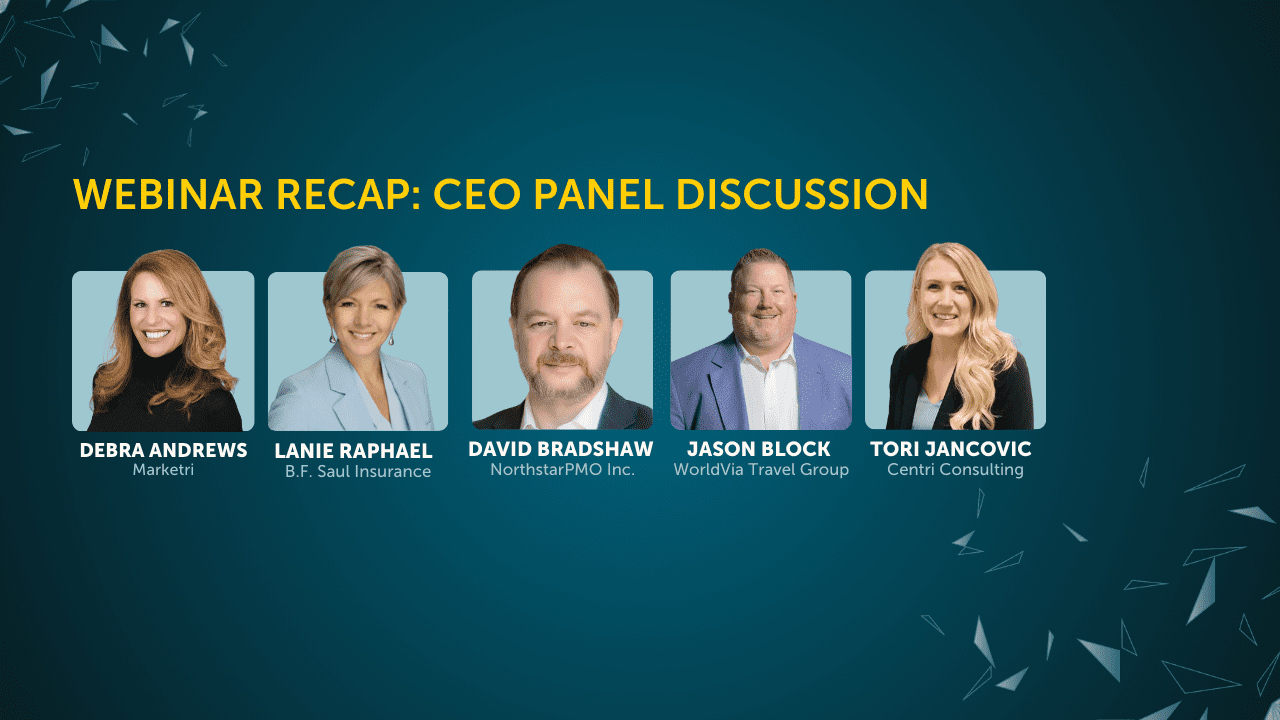
Smarter Ways CEOs Are Filling Leadership Gaps: Fractional Leadership Insights from Our CEO Panel
When growth stalls or market conditions shift, mid-market CEOs face a critical decision: do you hire a full-time executive with the risk of a lengthy ramp-up period and significant overhead, or do you find a more agile solution?
In our recent webinar, “Smarter Ways CEOs Are Filling Leadership Gaps,” we brought together a diverse panel of executives who’ve discovered that fractional leadership offers a third, often better path. The discussion revealed practical insights from both sides of the relationship—CEOs who’ve successfully leveraged fractional executives and the fractional leaders who’ve helped drive their growth.
The data speaks for itself: 72% of CEOs plan to increase fractional executive usage within 12 months, driven by 40-60% cost savings compared to full-time hires while maintaining strategic impact. But beyond the numbers, our panelists shared real stories of transformation, challenges overcome, and growth accelerated through this model.
The Turning Point: When CEOs Realize They Need Fractional Leadership
Every company’s journey to fractional leadership begins differently. For Lanie Raphael, President of B.F. Saul Insurance, the signal came during a seemingly simple marketing project.
“We had our idea, we put everything together, we went out and received quotes,” Lanie shared. “We had the quotes in hand, and we started a discussion to say, do we even know that this is really what we need? Is this the right type of project for what we’re trying to accomplish?”
That moment of honest questioning—recognizing they didn’t know what they didn’t know—led to a transformative partnership with Marketri that would reshape their entire marketing approach.
For Jason Block, CEO of WorldVia Travel Group, the catalyst was different but equally compelling. Coming out of the pandemic, his company needed to scale quickly after downsizing during COVID.
“Rather than try to bring on multiple different HR professionals in a very short period of time, we were looking for a variety of different skill sets that we needed to be able to deploy pretty quickly,” Jason explained. The fractional model provided immediate access to diverse expertise without the time and risk of multiple full-time hires.
The Foundation: Building Trust Through Deep Understanding
One of the most critical insights from our panel was how fractional leaders approach client relationships differently than traditional consultants or vendors. David Bradshaw, CEO of NorthStar PMO, emphasized the importance of creating psychological safety from day one.
“Getting the clients to open up is key, because information is power,” David noted. “You have to build that trust relationship early so that the client is willing to share everything with you. And that can be difficult, especially if you’re dealing with maybe the founder of a business, or somebody who feels like they haven’t done a good job in a certain area.”
This vulnerability is essential for fractional relationships to work. Deb Andrews, President and Founder of Marketri, described their systematic approach: “We’ve formulated what we call our due diligence process over the last 20 years, which really kind of immerses ourselves into our clients’ world to give us a 360-degree view of their business model.”
Tori Jancovic, Audit Support & Readiness Practice Leader at Centri Consulting, reinforced this principle from the finance perspective: “I like to get on site with them to gain first-hand insights into how the business operates, which allows me to interpret the financial data in different contexts.”
The Integration: Becoming Part of the Team
A recurring theme throughout the panel was the critical distinction between fractional leadership and traditional outsourcing. David put it succinctly: “Most people view outsourcing as, we’re going to take some work, we’re going to package it up, and we’re going to send it out. I view fractional HR as being the exact opposite. We’re going to find you some great resource, and we’re going to send it in to your company.”
This “sending in” rather than “sending out” philosophy manifests in practical ways. Jason described how his company treats their fractional HR leader from NorthStar: “My approach has been, number one, treat that person in that firm like I would treat any of our other executives on our team, and set that expectation internally that when our people ops leader says something, it’s as if one of our other executives said it.”
Lanie echoed this approach, noting that Marketri attends virtually every leadership meeting and staff meeting, fully immersing themselves in the company culture—even participating in team bowling tournaments and pickleball games. “Every industry has its own language, and when you have someone you’re working with so closely, they really get to pick up on that,” she observed.
The panelists agreed that embedding fractional leaders into daily workflows—through Slack, Teams, regular meetings, and company events—is essential for success. As Jason warned from a less successful experience: “I positioned myself as the keeper of the relationship, and everything flowed through me, and it was a terrible disaster, because I became the bottleneck.”
The Value Proposition: Freeing CEOs to Focus on Strategy
Perhaps the most compelling benefit of fractional leadership is how it liberates internal teams—especially CEOs and founders—to focus on their highest-value activities.
Lanie described the transformation at B.F. Saul Insurance: “We were finding that we were taking resources from within that are really insurance experts, and trying to have them help us formulate brochures and marketing pieces, and the reality is, the people who are insurance experts really need to be speaking to our clients.”
The complexity of modern business functions makes this delegation even more critical. As Lanie noted with surprise, “One of the most surprising features about working with the fractional marketing team has been to learn about how complex it is. We don’t just deal with one or two people. There’s a variety of different skill sets and expertise within marketing, and we couldn’t possibly, a company our size, take on all of those people.”
Jason highlighted the strategic advantage this creates: “It’s allowed certainly our whole executive team to step out of a lot of the HR function that we were trying to do off the side of our desk, and probably not doing a great job of it, to now where our participation is from the strategic guidance standpoint.”
The fractional model also provides remarkable flexibility for project-based needs. Jason described being able to quickly spin up a comprehensive compensation band review: “It was done within weeks. I could hardly think about spinning up an interview process on my own in that amount of time, and it was already done.”
The Accountability: Strategic Planning and Execution
One unexpected benefit that emerged from the discussion was how fractional leaders help maintain strategic focus amid the chaos of daily operations.
Lanie emphasized this point: “I think one of the key things for us was Marketri helped us develop a strategic plan. And we have one every year, and they really help us stay on point. In the background, our fractional CMO is thinking about where we are compared to our strategic plan, reminding us that we said we were going to, in the first quarter, do these specific three items.”
This proactive accountability—having someone who “wakes up every day thinking about those specific items”—prevents strategic initiatives from getting lost in the urgency of client work and daily operations.
The Partnership: When Fractional Companies Work Together
An interesting dynamic emerged when Deb Andrews shared Marketri’s experience as both a fractional marketing provider and a client of fractional HR services through NorthStar PMO.
“It’s the best when you have fractional companies that are working with each other,” Deb explained. After getting to know David and his team through their marketing relationship, Marketri engaged NorthStar for HR support. “It’s really nice for our team to have someone besides the founder to go to with maybe the questions or any issues that they might have.”
David appreciated the reciprocal trust: “It’s even more of a compliment, I think it’s the highest compliment if somebody has gotten to know you and your firm really well first, and then decides to partner with you.”
This partnership also demonstrates the value of having established relationships when new needs arise. David noted: “There’s no startup cost to doing that. You don’t have to go research, you don’t have to go find a partner, you don’t have to go through the discovery call process—you’re already set up to work together.”
Common Misconceptions: Duration and Scale
One of the most valuable portions of the discussion addressed common misunderstandings about fractional leadership engagements.
On Duration: Many CEOs assume fractional relationships are short-term fixes, but the panel revealed otherwise. Deb shared that Marketri’s average client relationship lasts 5 to 7 years. David emphasized that fractional models aren’t just for specific growth milestones: “It can be a very long-term, ongoing relationship that just grows and changes and evolves as the client grows.”
Jason agreed from the client perspective: “Once you find the right partner, these very much can be long-term and maybe forever relationships.”
On Scale: Another misconception is that companies eventually “outgrow” fractional leadership. David challenged this notion: “A client doesn’t get to the point where they say, okay, we now need one HR professional in-house, because that doesn’t work, because you won’t find that one person that has all of the skills you need.”
The fractional model provides access to multiple specialists—what might take a team of full-time employees—delivered through a flexible, scalable structure.
Key Takeaways for CEOs Considering Fractional Leadership
The panel offered several critical insights for CEOs evaluating this model:
Start with Integration: The most important onboarding step is team integration. As Lanie emphasized, fully embedding fractional leaders into your organization from day one sets the foundation for success.
Build the Relationship: Jason advised treating fractional leadership “almost like you’re dating, and making sure that there’s kind of a spark in a relationship early on.” Cultural fit matters as much as expertise.
Invest Time Upfront: Tori noted that “putting the time in in the beginning to get that person up to speed will definitely pay dividends on the back end.”
Set Clear Expectations: Tori highlighted the importance of defining roles clearly from the start, particularly when fractional leaders work alongside internal team members.
Think Long-Term: Don’t view fractional engagements as temporary stopgaps. The model works across growth stages and can evolve as your needs change.
Looking Ahead: The Future of Fractional Leadership
As the webinar concluded, one message resonated clearly: fractional leadership isn’t a compromise—it’s often the superior solution for mid-market companies navigating growth, market shifts, and increasing complexity.
Whether you’re facing the challenges Lanie described in marketing, Jason encountered in HR, or the financial pressure points Tori helps address, fractional executives provide seasoned expertise exactly when and where you need it, without the long-term overhead and risk of premature full-time hires.
The model delivers 40-60% cost savings while maintaining strategic impact, but perhaps more importantly, it provides access to diverse, specialized talent that would be impossible to assemble in-house at most mid-market companies.
Ready to Explore Fractional Leadership for Your Organization?
Whether you’re considering fractional marketing leadership, need strategic guidance in another functional area, or simply want to understand if this model makes sense for your growth stage, we’re here to help.
Watch the full webinar recording to hear additional insights from our panel of CEOs and fractional leaders, or explore our resources for more guidance on building scalable, right-sized leadership teams for mid-market growth.
Learn more about our business
Contact Marketri to discuss how fractional leadership could accelerate your growth, strengthen your team, and help you navigate your next growth milestone with confidence.