
The Strategy Tax: The Hidden Cost of Marketing Without a Plan
By Deb Andrews
Originally Published
No CFO would ever approve a business plan without a defined strategy. Yet (too) many companies approve marketing budgets every year without a clear marketing blueprint. Instead, they rely on a list of tactics: a new agency, a refreshed website, “more leads”, a couple of campaigns and, maybe, another tool.
A marketing strategy, just like a business strategy, is not optional when it comes to successful growth. Too often businesses get caught in the trap of reactive marketing: leaning too heavily on tactics without a strategic roadmap in place.
The disconnect creates what we call the “strategy tax”: the premium you’re paying when marketing lacks a strategic framework and isn’t anchored to a deliberate plan for how the business is going to win in the market.
It’s not just inefficient. Over time, it will quietly undermine the business strategy marketing is supposed to support.
If a Business Strategy Is Non-Negotiable, Why Isn’t a Marketing Strategy?
According to DemandScience’s “The 2026 State of Performance Marketing”, roughly 25% of the average marketing budget is spent on campaigns that look great in a dashboard but have no impact on revenue.
With a marketing strategy, you not only create efficiencies within your organization, but you also create excitement for the products and services you’re selling.
Your business strategy answers questions like:
- Where are we playing? (markets, segments, geographies)
- How do we win? (differentiation, pricing power, delivery model)
- What capabilities do we need? (sales motion, customer success, product roadmap)
- What outcomes are we targeting? (growth, margin, valuation, risk profile)
Marketing strategy answers:
- Who we target (ICP and priority segments)
- What we say (positioning, messaging, proof)
- Where we show up (channels that match the buying journey)
- How we create demand and accelerate pipeline (offers, nurture, enablement)
- What we measure (leading indicators tied to revenue outcomes)
When the business strategy is clear but the marketing strategy is not, marketing becomes reactive. It chases the loudest internal request, the newest idea, or the latest “best practice.” The result: motion without traction.
When your team is lacking a strategic framework and solely focused on task-based marketing, your team of hard-working “do-ers” become just that: a team of do-ers with no strategic (nor positive financial) impact. Leadership included.
Efforts become arbitrary instead of focused, decisions become reactive instead of proactive, your marketing and sales teams are struggling, and growth has stalled.
You’re paying the “strategy tax.” And I doubt that was built into this year’s fiscal budget.
Why Mid-Market CFOs Need to Care About the “Strategy Tax”
If you’ve heard the phrases “random acts of marketing”, “shiny object syndrome”, or “spray and pray marketing” recently and thought, “Wow, this resonates with our current efforts.” You’re very likely paying the “strategy tax.”
According to a recent report, 85% of teams spend more than half of their time fixing problems: cleaning up data, trouble-shooting underperforming campaigns, and reconciling disconnected systems.
The “strategy tax” is the cost of doing marketing without a coherent strategy. It can show up in several ways in mid-market B2B organizations:
- Agency churn every 12–18 months: The first agency “doesn’t get our business.” The next one changes the messaging again. Then a third comes in to “fix” the first two. It’s hard for vendors to be successful without a strategic foundation.
- Messaging changes every year (or every quarter): Not because the market changed because alignment never existed in the first place.
- Sales frustration, “These leads aren’t right.”: Marketing reports volume. Sales reports low conversion. Everyone blames “lead quality,” but the real issue is targeting and buying-journey mismatch.
- Activity without pipeline velocity: Lots of content, emails, webinars, ads and still no improvement in sales cycle length, win rate, or deal size.
- Spend increases without conversion improvement: More budget goes in. CAC doesn’t improve. Forecast confidence doesn’t improve. The board starts asking harder questions.
This is the impact of lacking a marketing strategy: you don’t just lose efficiency, you lose confidence. And in finance, confidence is a currency.
So, while 25% of your organization’s marketing efforts look great in a dashboard, the real impact of lacking a marketing strategy is showing up—or not showing up, rather—in your revenue.
The Cost of Not Having a Marketing Strategy
Assume a mid-market B2B firm with a $1.5M annual marketing budget (not unusual in the $30M–$150M revenue range, depending on growth goals and industry).
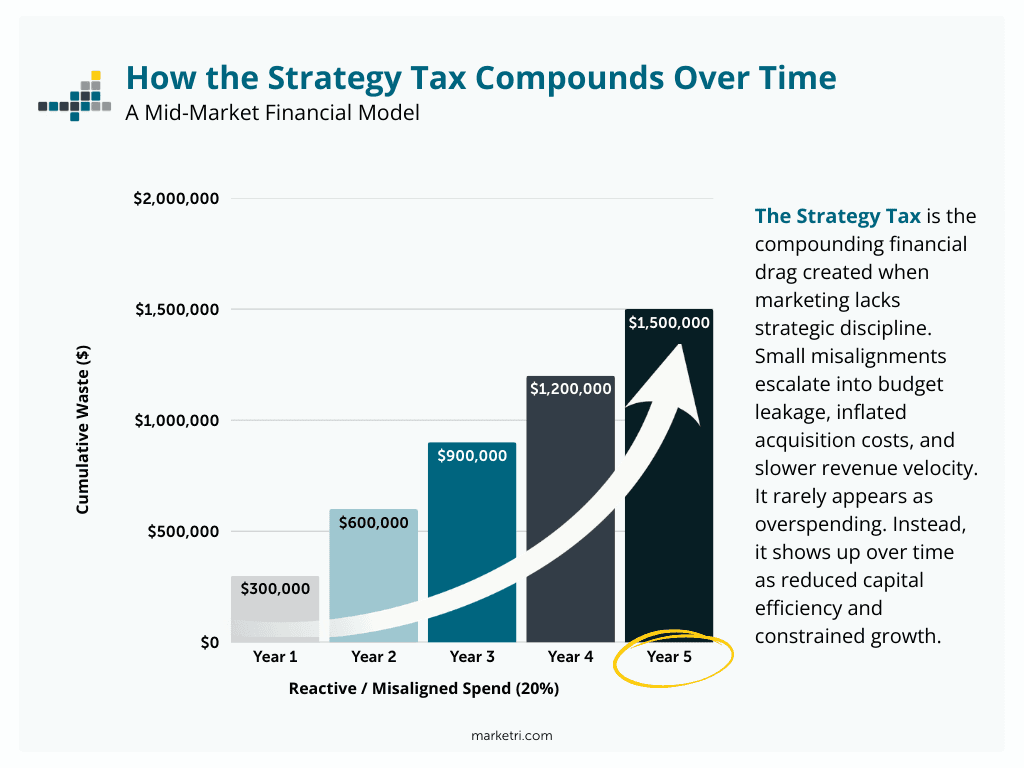
Now assume that 20% of that spend is misaligned or reactive—wrong audience, unclear message, channel mismatch, constant rework, disconnected campaigns.
- Annual “strategy tax”:
$1.5M x 20% = $300,000 per year - Over five years (direct cost only):
$300,000 x 5 = $1.5M
That’s the visible part. The bigger cost is compounding:
- Extended sales cycles: If unclear positioning forces Sales to educate from scratch, your cycle length creeps up. That impacts capacity planning and forecast accuracy.
- Lower conversion rates across the funnel: Small drops at each stage compound. A slightly worse MQL-to-SQL conversion plus a slightly worse SQL-to-close rate can easily create a meaningful revenue gap.
- Higher CAC (even if CPL looks “fine”): Cheap leads that don’t convert are still expensive—because Sales time is expensive.
- Internal productivity drain: Industry research consistently shows teams spend an outsized amount of time fixing, revising, and reworking marketing outputs when strategy isn’t clear—time that should be spent creating and compounding assets.
- Platform and tooling creep: When results aren’t improving, teams often add tools. Many organizations report rising MarTech costs without a clear improvement in ROI. Tools aren’t the enemy, but tool purchases are often a symptom of strategic ambiguity.
Bottom line: the cost of not having a marketing strategy is rarely just wasted media dollars. It’s wasted organizational effort plus delayed or discounted revenue.
The CFO’s Core Question: “How does marketing investment translate into revenue growth?”
This is the right question. And it deserves a better answer than “we need to build awareness.”
Marketing is not a vending machine where you insert dollars and receive revenue on a fixed schedule. But it can behave like disciplined capital allocation—if the company is clear on the strategy and governance.
A marketing strategy improves revenue performance by creating clarity in four areas that directly affect conversion:
- ICP clarity (who we’re really built to win)
- Fewer “random” leads
- Better qualification
- Higher win rates and better retention
- Buying drivers and messaging (why us, why now)
- Less time spent explaining basics
- Stronger differentiation
- Better close rates in competitive deals
- Channel focus (where demand is realistically created)
- Reduced scattershot spending
- Fewer “test-and-pray” campaigns
- Faster learning cycles
- Measurement that ties to revenue outcomes
- Not just vanity metrics
- Leading indicators that Sales and Finance can trust (conversion rates, pipeline velocity, CAC payback, win rate by segment)
So, does marketing strategy improve ROI? Yes—because it reduces rework, increases signal clarity, and improves conversion economics. It makes your spend more predictable and your growth less reactive.
The conundrum is that CFOs rely on quantifiable answers. In this complex digital era of marketing, it is increasingly difficult to measure direct attribution for ROI. Some marketing efforts such as customer loyalty and brand value are difficult to quantify but are incredibly important because those types of strategic investments build the strongest value long-term.
Difference Between Marketing Strategy and Tactics in B2B (and Why It Matters)
In B2B marketing, tactics are the visible activities:
- campaigns, ads, events
- content, webinars, email sequences
- SEO updates, website redesigns
- new tools, new agencies
Strategy is the set of choices that make those tactics coherent:
- target segments and ICP
- positioning and message hierarchy
- go-to-market motions (inbound, outbound, partner-led, account-based)
- funnel architecture and handoffs with Sales
- measurement plan tied to revenue outcomes
This is why marketing tactics don’t drive revenue growth on their own. Tactics without strategy create randomness:
- You can generate activity without pipeline.
- You can generate leads without conversions.
- You can spend more without improving CAC or payback.
Tactics are multipliers. Strategy is what they multiply.
If the strategy is unclear, more tactics just multiply the confusion.
Why Strategic Marketing Matters for CFOs
Finance teams are expected to support growth efforts without losing control of spending. According to SAP Concur research, 35% of CFOs say poor cost management is now one of the top internal threats to their business. In 2026, finance teams are focusing on “operating with confidence in an environment that still feels unpredictable.”
“Being ahead is not about squeezing budgets harder. It is about creating stability in an environment where change is constant.” – SAP Concur, 6 Ways Top Finance Leaders Are Staying Ahead of Spend in 2026
Eliminate the “Strategy Tax” from the list of unpredictability by shifting from reactive to proactive spend management.
CFOs care about:
- predictability
- efficiency
- risk management
- governance
- profitable growth
A real marketing strategy supports all of those:
- Greater forecast confidence: Clear segments, clear message, and consistent execution create more stable conversion patterns.
- Lower variance in performance: Instead of swinging between “big quarters” and “why did pipeline dry up,” you build repeatable demand.
- Less waste and fewer resets: When strategy is documented and owned, the organization doesn’t restart every time an agency changes or a marketing leader turns over.
- Better alignment with Sales capacity: Demand generation that ignores Sales reality creates backlog or wasted opportunity. Strategy forces coordination.
- Stronger board narrative: When asked, “What’s the growth plan?” you can answer with more than a channel list. You can show choices, rationale, and metrics.
Without a marketing strategy, you lose operational leverage. Strategic marketing restores it.
Strategy Before Scale (How Marketri Helps Mid-Market B2B Firms)
It’s likely you don’t need more marketing activity. You need more marketing discipline aligned with business strategy. Most mid-market teams don’t have the bench strength to build all of this internally, especially while still running day-to-day marketing.
Marketri’s approach is simple: strategy before scale. We help you build the strategic foundation to fuel your growth engine before you pour more dollars into tactics.
Where we typically help:
- Marketing strategy consulting before tactical investment: Clarify ICP, positioning, channel priorities, funnel architecture, and the measurement plan Finance can trust.
- Branding and messaging clarity before campaigns: So, you stop rewriting the story every year, and Sales stops improvising the pitch.
- Fractional marketing leadership to implement governance: Experienced leadership without the full-time overhead, creating cadence, accountability, and cross-functional alignment.
- Marketing transformation for firms that have grown without structure
If growth happened “organically” but systems didn’t keep up, we help you professionalize without overbuilding.
This is designed for mid-market realities: limited bandwidth, high accountability, and no margin for waste.
Stop Paying the “Strategy Tax”
You would not run your business without strategy. Don’t run your growth engine without one, either.
If you suspect you’re paying a “strategy tax”—through churn, rework, rising spend, or inconsistent pipeline— Marketri can help you build a strategy that turns marketing from a cost center into a managed growth system.
FAQ
What is a “strategy tax?”
The “strategy tax” is the hidden cost of doing marketing without a clear, documented marketing strategy. You pay it in wasted spend, rework, misaligned campaigns, and delayed revenue—plus the downstream cost of longer sales cycles and lower conversion rates.
What’s the difference between marketing strategy and marketing tactics?
Strategy is the set of choices that create focus—who you target (ICP), how you position, which channels you prioritize, what the funnel needs to do, and how you’ll measure success. Tactics are the activities (campaigns, content, events, ads, tools) that execute those choices. Tactics without strategy often create activity without meaningful pipeline impact.
How do I know if my company is paying the “strategy tax?”
Common signs include frequent agency changes, repeated messaging “refreshes,” Sales saying “the leads aren’t right,” lots of marketing activity with little pipeline velocity improvement, and rising spend without better conversion or CAC payback.
What does marketing strategy actually do for revenue performance?
It improves the economics of growth: clearer ICP targeting increases win rates; stronger positioning reduces the amount of “education” Sales must do; channel focus reduces scattershot spend; and better measurement creates leading indicators Finance can trust (conversion rates, pipeline velocity, CAC payback).
What should a CFO expect to see in a credible B2B marketing strategy?
A clear ICP and prioritized segments, positioning and message hierarchy, channel and go-to-market motion choices, funnel stages and Sales handoffs, and a measurement plan tied to revenue outcomes—not just awareness metrics.
Ready to turn your marketing into a measurable revenue generator?
Subscribe to our newsletter to learn how fractional leadership could accelerate your growth, strengthen your team, and help you navigate your next growth milestone with confidence.