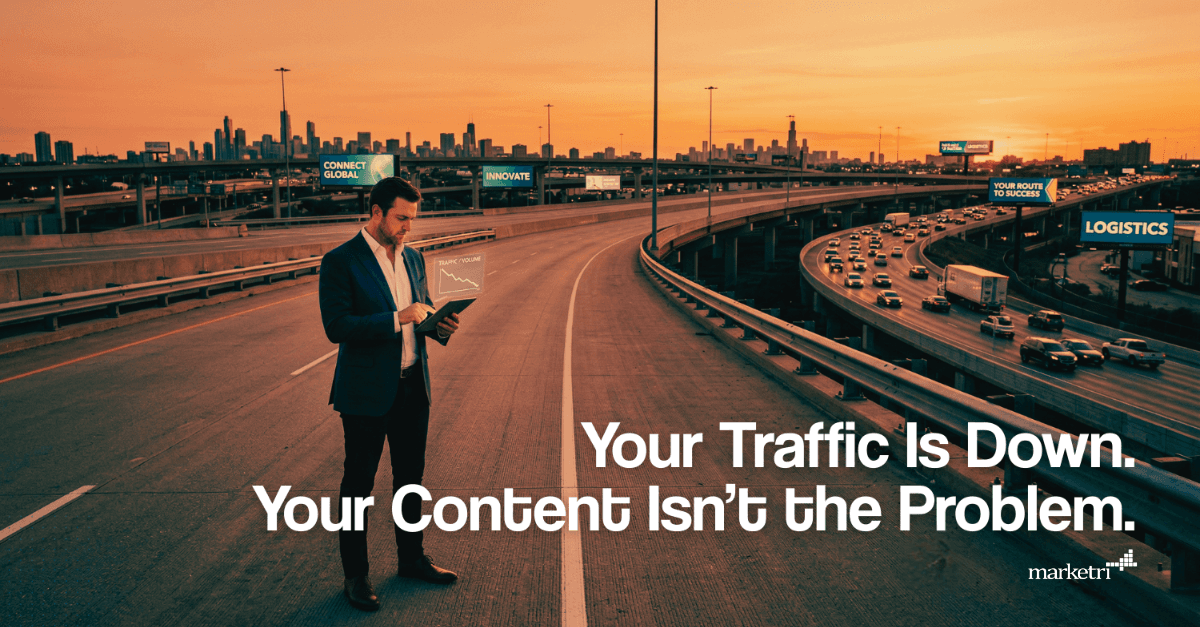
Your Traffic Is Down. Your Content Isn’t the Problem.
By Deb Andrews
Originally Published
It’s Tuesday morning. You open your analytics dashboard like you always do, coffee still too hot to drink, and something just feels… wrong.
Impressions? Up. Rankings? Holding. Traffic? Down. Again.
You didn’t cut corners. Your team published consistently. The keyword strategy was solid. And somehow, fewer people are landing on your site than they were eighteen months ago.
Here’s the thing I want you to sit with for a second.
That’s not a you problem.
That’s the zero-click reality. And if you’re running a B2B company and haven’t had a real, honest conversation with your leadership team about what it means for your pipeline, that conversation is overdue.
Your content didn’t fail. Google absorbed it.
Let me tell you what’s actually happening out there.
Nearly 60% of all Google searches now end without a single click to any website. Not 20%. Not 30%. Six out of ten. And when Google’s AI Overviews are in play, that number jumps to around 83%. Eight out of ten people who see an AI-generated answer never leave the search page.
Think about the queries that used to drive your top-of-funnel traffic. “What’s the difference between X and Y?” “How do you evaluate vendors for this category?” “Best practices for managing Z in a mid-size operation.” That was your bread and butter. That was the content you spent real budget on.
88% of queries triggering AI Overviews are informational, which is the exact content type that traditionally drove B2B traffic. Your buyers didn’t stop asking those questions. They just stopped needing to visit your site to get the answers.
It’s like building a beautiful highway that people used to travel, and then Google quietly put a bypass around it. Your billboards are still there. People still see them in the overview. But the exit? They’re skipping it.
The most frustrating part: your content might actually be the source powering that AI answer. You just don’t get the click. Or the credit.
Traffic was never really the goal, was it?
Real talk. When did “getting clicks” become the actual business objective?
Traffic was always a proxy metric. A stand-in for what we actually cared about, which was getting our expertise in front of the right buyers at the right moment. We built entire content strategies around driving people to our website because that was the mechanism. The website was the destination.
AI search is making the website optional. Not irrelevant. Optional.
That distinction matters enormously for how you lead your marketing organization right now.
The shift worth making is from a traffic-first mindset to a visibility-first one. Think of it in three levels.
Level 1 is Traffic Obsession. Success measured in sessions and pageviews. Content designed to force the click. This was the game for twenty years. It’s not dead, but it’s incomplete. If you’re still here, you’re already behind.
Level 2 is Answer Optimization. Creating content that AI systems can extract, cite, and surface. Getting your brand mentioned inside the AI Overview even without the click. This is the transition layer that most mid-market B2B companies are missing entirely right now.
Level 3 is Authority Positioning. Becoming the source that AI engines consistently reference. Not just Google. Perplexity. ChatGPT. Gemini. Microsoft Copilot. Your buyers are using all of them to research decisions. The question is whether your expertise shows up when they do.
Most companies are still playing Level 1. The opportunity is enormous for anyone willing to move.
Why this hits mid-market companies hardest
Enterprise companies have armies of content producers and domain authority built over decades. Smaller companies move fast but have thin libraries. Mid-market companies, the $10M to $500M range, often invested most heavily in content precisely to compete with enterprise players on an even field.
73% of B2B websites experienced significant traffic loss between 2024 and 2025. And here’s what stings: this isn’t about bad content or a bad agency or a bad strategy. It’s a structural market shift. The rules changed.
But here’s the flip side that most people aren’t talking about.
Mid-sized companies move faster than enterprise. You can restructure your content approach in 90 days. A Fortune 500 competitor with seventeen approval layers and a brand governance committee? Still in meetings about it.
The window is open. It won’t stay open forever.
Three moves that actually matter right now
So. What do you do?
Optimize your content for extraction, not just reading.
AI systems favor content that’s clearly structured and directly answers questions. Lead each section with a concise, direct answer before you expand into nuance. Use question-based headings that mirror how people actually search. Add FAQ schema markup on your key pages. Bullet points. Comparison tables. Numbered steps. These aren’t just good formatting choices, they’re signals that help AI parse and cite your content. 44% of all LLM citations come from the first 30% of a piece of content, so your intro and your opening answers matter more than you think.
Build your entity, not just your website.
This one’s underrated and underexecuted. AI engines don’t just index websites. They recognize entities: companies, people, and concepts that appear consistently across the web. Your brand needs consistent, accurate presence on LinkedIn, Crunchbase, Wikidata, industry directories, and reputable third-party publications. Expert commentary in trade press. Original research your team has actually conducted. The goal is for AI to recognize your company as a credible, citable source, not just a domain with some pages on it.
Redesign how you measure success.
Your current attribution model was built for a different internet. If organic traffic is still your primary content KPI, you’re flying blind in a storm. Start tracking branded search volume growth, a reliable signal that AI-driven awareness is working even when you can’t see the clicks. Monitor your citation rate inside AI Overviews using Google Search Console. And go old school: ask your leads how they first heard of you. You’ll be surprised how often the answer is “I saw you mentioned in a search result” without a single click ever recorded in your analytics.
The conversation your leadership team needs to have
Here’s the version of this that keeps CMOs up at night. The CFO sees traffic declining and wants to cut the content budget. Logical conclusion. Incomplete data set.
The right response isn’t defensiveness. It’s a reframe.
“We’re not publishing less. We’re publishing differently. We’re not chasing clicks. We’re building authority that shows up inside every AI platform our buyers are using. The old metrics look scary because they’re measuring the wrong thing.”
The organizations best positioned aren’t those with the highest SEO budgets. They’re the ones who understand what actually triggers their buyers to start researching, what questions they ask, and where in the AI conversation they develop confidence to engage.
The companies that pull back on content right now because the traffic number looks bad are making a serious strategic error. The companies that figure out the new game early will own the AI-cited authority landscape for years. In B2B, that kind of positioning compounds over time, just like trust always has.
Back to that Tuesday morning
The number you’re staring at tells you how many people clicked. It doesn’t tell you how many people encountered your expertise, absorbed your thinking, and started their buying journey with your brand already in their head.
The zero-click reality isn’t the death of content marketing. It’s the maturation of it. The shift from broadcasting to authority. From traffic to trust. From “did they visit us” to “did they find us when it mattered.”
96.55% of content now gets zero traffic from Google. That’s a brutal number. It’s also the greatest opportunity to differentiate that most B2B companies have seen in a decade, because almost nobody is optimizing for the new game yet.
The real question isn’t how many people visited your site this month.
It’s how many buyers made better decisions because your expertise showed up when they needed it, even if you never saw them coming.
That’s the game now. And the good news? It rewards exactly what great B2B companies were always supposed to be doing: creating genuine expertise, sharing it generously, and building the kind of credibility that earns a seat at the table before the conversation even starts.
The click was never the point.
The influence was.
Ready to turn your marketing into a measurable revenue generator?
Subscribe to our newsletter to learn how fractional leadership could accelerate your growth, strengthen your team, and help you navigate your next growth milestone with confidence.
Article Sources:
- https://www.position.digital/blog/ai-seo-statistics/
- https://www.onely.com/blog/zero-click-search-is-evolving-into-zero-search-discovery/