


There Is No “Typical” Day for a Fractional CMO. That’s Exactly Why It Works.
By Deb Andrews
Originally Published
People like to imagine a clean answer to the question. What does a day in the life of a fractional CMO look like?
They expect a schedule. Time blocks. Strategy at 9:00. Standup at 10:30. Content approvals at 4:30. And yes, those things happen. But if I’m honest, the job isn’t about a schedule. It’s about shifting contexts and making connections that matter. By 6:30 in the morning, I’m already in five industries.
Two investment banks. A technology firm. A SaaS company. A supply chain consulting firm. Five CEOs. Five growth agendas. Five different levels of marketing maturity. The day begins before any meeting starts.
Coffee. The New York Times. The Wall Street Journal. A mix of political analysis and AI newsletters. Then LinkedIn, but not to scroll mindlessly. I scan for signals. A competitor announcing a new hire. A regulatory shift that could affect a client’s sector. A funding round that changes the competitive landscape. If you are advising CEOs, context is not optional. You do not get to show up uninformed.
That early hour is less about headlines and more about orientation. What changed overnight that might matter?
By 9:00, I am usually in conversation with one of five CEOs. Two investment banks. A technology firm. A SaaS company. A supply chain consulting firm. Each one with its own set of goals, pressures and ambitions.
In one company, we are refining an existing engine. The playbook is in place and we are tuning performance, measuring acquisition costs, and sharpening messaging so it reflects the level of sophistication the firm has reached. In another, we are still building the foundation. The company has grown through relationships and reputation, but the narrative has not evolved with the business. We are defining how it presents itself in a more crowded, more competitive environment.
Same title. Different mandate. That is the nature of the role.
These conversations are rarely abstract. We talk about hiring plans, budget tradeoffs, board expectations, and pipeline velocity. If deals are slowing, we examine why. If sales feels friction in conversations, we dig into the story they are telling. Marketing needs to embrace all parts of the business and not live in isolation. It needs to sit directly in the path of revenue
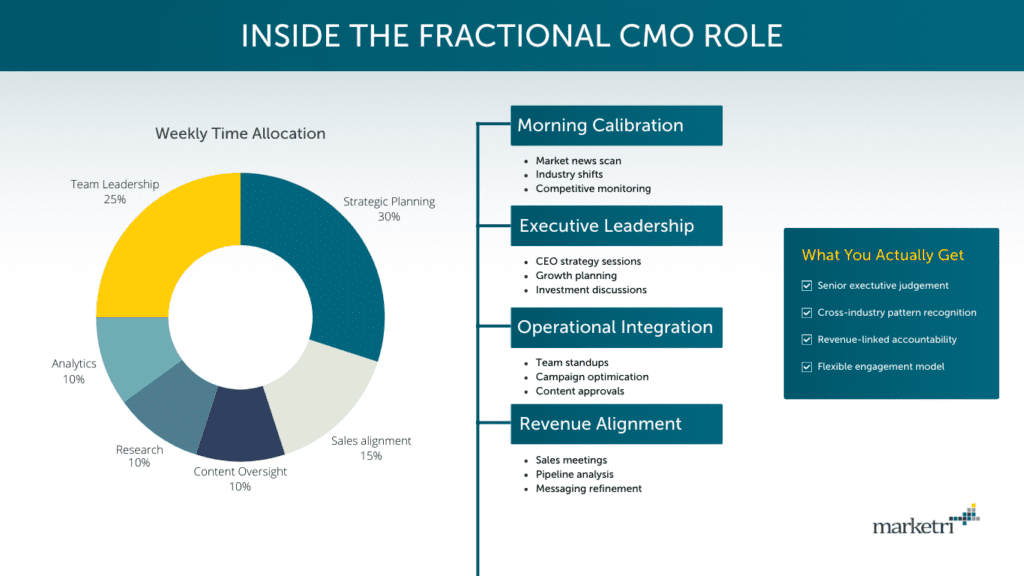
By mid-morning I move into more of an operational role. Standups with marketing managers. Reviews of campaign performance. Discussions about what to stop, what to adjust and what to test next. Our teams operate remotely, but they are tightly integrated. Workplans are mapped weeks in advance. KPIs are visible and accountability is shared.
There is also a persistent myth that senior marketing leaders float above the work, contributing only high-level ideas while others handle execution. That has not been my experience. I review copy. I rewrite sections of websites when the language feels generic. I challenge positioning that sounds interchangeable with competitors. I weigh in on media strategy and vendor selection. I ask uncomfortable questions when a campaign feels busy but not productive.
Leadership, in this fractional model, is about leaning into the details and about knowing which details actually matter.
The part that takes the most energy, and often the least visibility, is research. I was trained early in my career to go beyond the surface, and that habit has never left. If an investment banking client wants to enter a new subsector, I am reading earnings transcripts and tracking regulatory shifts, not just scanning websites. If a SaaS firm keeps losing to the same competitor, I want to understand how those conversations unfold, where confidence falters, and how the buyer interprets the story.
Working across five companies accelerates pattern recognition. You start to see common themes in how markets shift, how buyers hesitate, how organizations resist change. An insight from a supply chain engagement might inform how a technology client frames operational transparency. A lesson from one investment bank sharpens the positioning of another.
That cross-pollination is one of the quiet strengths of the fractional model. You are not buying isolated advice. You are benefiting from perspective earned across industries and stages of growth.
In the afternoon, the work often becomes more collaborative. Positioning workshops where founders defend language they have used for years. Sales alignment meetings where teams voice their objections. Vendor reviews where we decide whether the current stack supports the ambition of the business.
When we align marketing and sales around the same narrative, conversations with customers feel more natural.
Later, I am usually in a revenue meeting, looking at the numbers with cross functional teams. Which campaigns are producing qualified leads? Where are deals stalling? What objections keep repeating? The CEOs I work with do not care how many posts we publish or how many impressions we generate. They care about their pipeline. They care about growth, margin, and predictability. Marketing must contribute in a way that can be measured.
CEOs sometimes worry that fractional means diluted commitment, that attention is divided and therefore less serious. What they discover is that time allocation may be structured, but ownership is not. The responsibility to move the business forward is real.
Some days are heavy on strategy. Others are consumed by execution. Occasionally, the day is defined by a difficult conversation about what is not working and what needs to change. The variability is inherent in the job. Moving between contexts without losing momentum is part of the discipline.
So when someone asks what a typical day looks like, I hesitate to offer a tidy answer. The role is rarely defined by a predictable schedule. It is instead about sustained leadership across shifting priorities, markets, and growth stages.
If you are a CEO considering this model, the more useful question is not how the hours are arranged. It is whether you want marketing advice delivered periodically or marketing leadership that stays close to the business, close to revenue, and close to the decisions that shape your future.
The calendar will always change. The responsibility does not.
Ready to turn your marketing into a measurable revenue generator?
Subscribe to our newsletter to learn how fractional leadership could accelerate your growth, strengthen your team, and help you navigate your next growth milestone with confidence.

Learn About The Power Of Marketing Strategically

What an AI Readiness Assessment Tells a Marketing Team
Merged teams, mismatched AI tools? See how an AI readiness assessment helps marketing leaders find real savings before building a roadmap.

How Much Does a Fractional Marketing Team Cost?
When B2B buyers ask how much a fractional marketing team costs, they want a real answer, not "it depends." This post breaks down the actual range, from $5,000 to $75,000 a month, and the variables that determine where your company lands in it.

The Marketing Forecast: Grading My 2026 Calls and Making Bolder Ones for 2027
Deb grades her own 2026 marketing predictions, then makes six bolder calls for 2027, from the death of traditional SEO to why trust-based channels will win the budget.

How to Choose a Fractional Marketing Partner
Fractional marketing comes in two flavors, and the difference matters more than most buyers realize. Here's how to evaluate the right partner for your business.
Subscribe to our Newsletter
By subscribing, you agree to receive marketing emails from Marketri. See our Privacy Policy.