
From Curiosity to Commitment: How Midmarket CEOs Are Navigating the AI Revolution
By Deb Andrews
Originally Published
AI isn’t just knocking at the door of B2B companies anymore; it’s moved in, unpacked its bags, and is actively reimagining the house.
To understand what this shift really looks like in the boardroom, we gathered insights from midmarket B2B CEOs and industry leaders across sectors, from tech to healthcare to professional services. The result is a candid snapshot of opportunity, experimentation, and cautious optimism.
AI Is Inevitable—And CEOs Are Guiding The Next Wave
From automating repetitive tasks to transforming entire business models, AI has become a force multiplier across industries. But what separates organizations that merely dabble in AI from those that drive real competitive advantage? CEO leadership.
Across the board, awareness of AI is high. Every CEO we spoke to had at least a working knowledge of tools like ChatGPT, Perplexity and Claude. Many have incorporated AI into their workflows. But what’s most telling is how they frame AI: not as a shiny object, but as a strategic lever—and decisions around its adoption are weighty. The pace of change is unforgiving and sitting still is not an option. Today’s leaders must build clear roadmaps that outline not just how to implement AI, but how to integrate it into their organizational culture across functional areas.
As Andy Jassy, CEO of Amazon put it in a recent WSJ interview: “Generative artificial intelligence is going to reinvent virtually every customer experience and enable new ones.” This sentiment resonates deeply with those we talked to in the C-Suite, highlighting the transformative potential of AI.
AI’s Staging Ground: Marketing and Customer Service Pave the Path for Wider Adoption.
A recent BCG study stated that “A full 90% of the leaders surveyed believe that in the next three years, GenAI will be important or fundamental to marketing, sales, and service processes.”
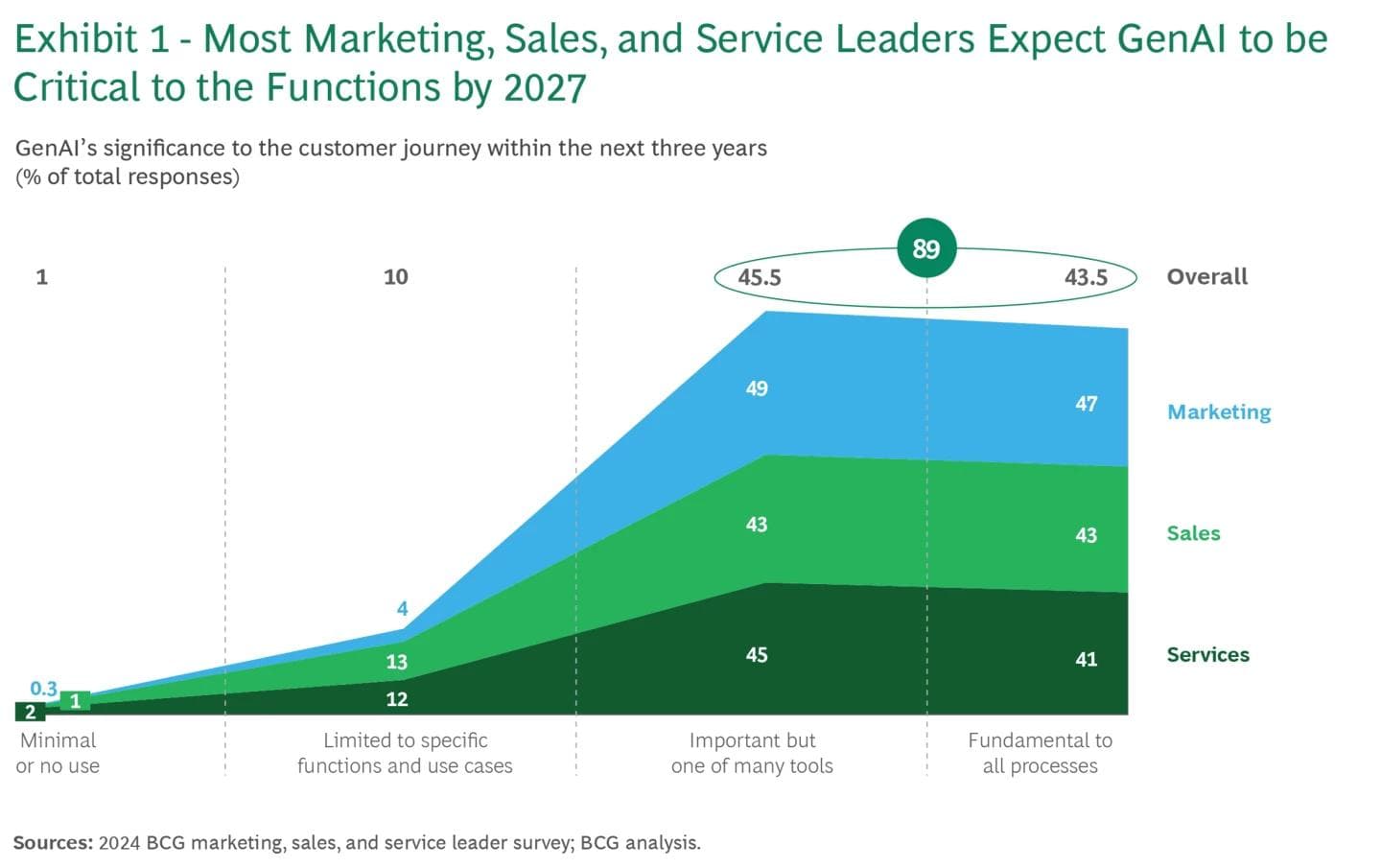
But today, most CEOs describe their organizations as only being in the “pilot phase,” using AI to automate workflows, personalize content and improve customer interactions. The experiments are small, but the impact is already changing the game. In the same BCG study, early adopters in marketing, have been able “to triple the speed of producing marketing content and reduce production costs by 70%.”
In a recent panel discussion, Dan Slagen, the CMO of Tomorrow.io said, “We look at every single one of our go-to-market processes… to understand which step should be owned by a human, which should be owned by AI, which should be a hybrid of the two, and why.” This pragmatic approach to testing and integration is characteristic of the current phase.
One example of this pragmatic approach in action is in customer service operations. AI shouldn’t just automate processes; it should amplify strengths and shrink weaknesses and free up time for more high value tasks. Strategically deploying AI-driven chatbots and virtual assistants, organizations are seeing immediate benefits in automating customer service operations.
These AI solutions handle a vast number of queries simultaneously, providing instant responses 24/7 allowing human resources to focus on the more complex and nuanced interactions that require human empathy and strategic thinking, ultimately contributing to revenue growth.
Overcoming Barriers: The CEO as Change Agent
AI transformation is rarely smooth, revealing a critical gap between CEO optimism and organizational execution. One of the most significant challenges CEOs face is ensuring their AI initiatives deliver tangible results.
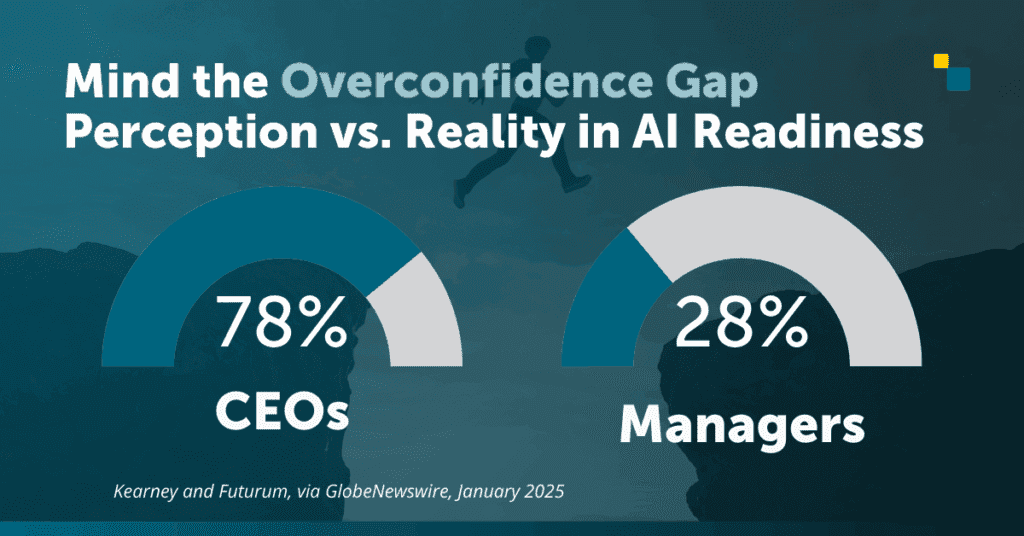
However, another study by Kearney and Futurum reveals a striking disconnect: while 78% of CEOs are confident in their AI leadership, only 28% of their mid-level managers agree. This ‘overconfidence gap’ can lead to misalignment and hinder effective implementation, potentially derailing AI initiatives and wasting valuable resources.
Cross-functional misalignment, outdated workflows, and talent shortages are common hurdles. AI presents challenges and opportunities for CEOs across the organization, from integrating legacy tech stacks to embedding compliance into every AI decision from day one. CEOs must create environments where experimentation is encouraged, and failure is seen as a learning opportunity.
Furthermore, AI thrives in environments where data, tech, and marketing teams collaborate seamlessly. Traditional departmental boundaries are ill-suited for the demands of AI. Shifting to cross-functional pods instead of siloed departments is one trend as CEOs champion tools and structures that integrate AI insights into everyday workflows. This alignment unlocks AI’s full potential across the enterprise.
Measuring ROI and Iteration: The CEO’s Focus on Tangible Results
Vision is nothing without measurement. CEOs must champion data-driven decision-making when evaluating AI’s effectiveness. That includes traditional KPIs like conversion rates and campaign lift, but also new ones like time saved, campaign velocity, and human hours redirected to higher-value work.
Start small, scale fast. Piloting AI in high-impact, low-risk areas provides proof of concept while building internal confidence.
Navigating the Talent Landscape: A CEO-Driven Imperative
AI fluency is now a core leadership competency. Yet many companies lack the talent to fully capitalize on AI opportunities. According to Deloitte, 68% of organizations report a moderate-to-extreme skills gap in their organizations when it comes to AI. Finding and retaining skilled AI professionals is a major hurdle. CEOs must address this head-on.
In some cases, they are exploring hybrid models—pairing internal champions with external AI-savvy partners like fractional teams and specialized agencies. Others are investing in training to upskill existing teams and instill an “AI-first mindset.”
As corporate roles evolve, future teams need to be comfortable navigating ambiguity, interpreting machine insights, and working in cross-functional environments.
“We don’t have time to build the expertise from scratch,” said one of the founders we spoke to. “Fractional leadership has helped us move quickly, without the long hiring cycles.”
Others noted that fractional leaders bring not just speed, but objectivity and pattern recognition. “They’ve seen what works—and what doesn’t. That’s invaluable when the cost of getting AI wrong can be high and time consuming,” one CEO noted. “Fractional marketing leadership will be key to scaling AI responsibly. These leaders bring not only hands-on expertise but also objectivity, cross-industry perspective, and speed. With their expertise, we can leap-frog the learning curve.”
Several predicted that the rise of AI will further accelerate the demand for embedded external talent—especially leaders who can blend strategy, tech fluency, and change management.
Early Adopters or Fast Followers? A Strategic Split
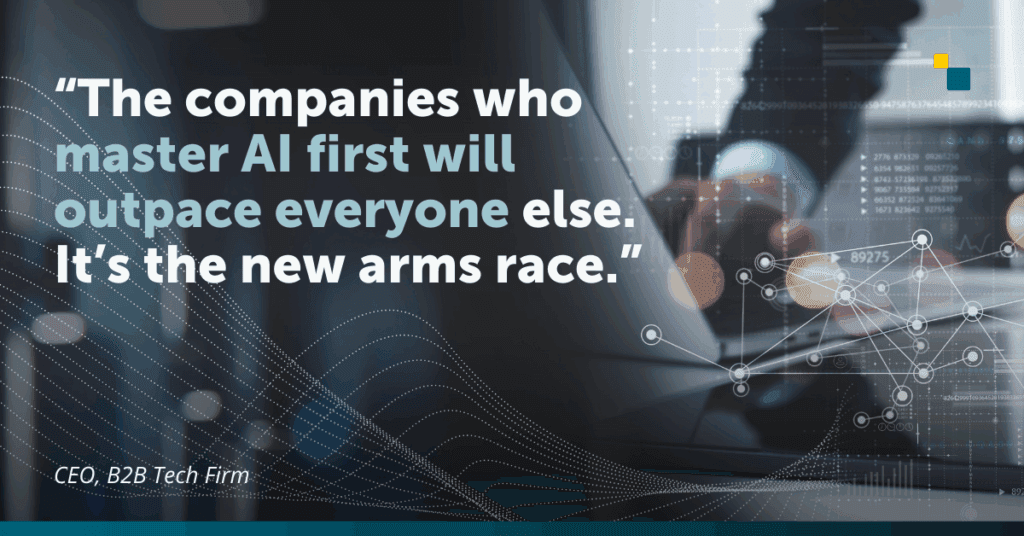
CEOs are split on how aggressively to adopt. Some see first-mover advantage as critical: “The companies who master AI first will outpace everyone else. It’s the new arms race.” — CEO, B2B Tech Firm
Others prefer a more cautious approach, especially in regulated spaces. Yet all agree on one point: standing still is not an option.
Looking Ahead: Opportunities and Challenges
The CEOs we spoke with are optimistic about the future of AI in B2B marketing. They see significant opportunities for personalization, automation, and data-driven decision-making. However, they also acknowledge the challenges related to ethical considerations, data privacy, and the need for responsible AI development.
For midmarket CEOs ready to embrace this evolution, the message is clear: start small, measure impact rigorously, and scale strategically. Companies that act now will set themselves apart as leaders in an increasingly competitive landscape. This is not just about adopting new technology; it’s about fundamentally rethinking how we approach marketing in the age of AI.
As CEOs cast their gaze to the horizon, many envision a future where marketing becomes truly predictive, personalized, and proactive. And yet, the human element remains vital.
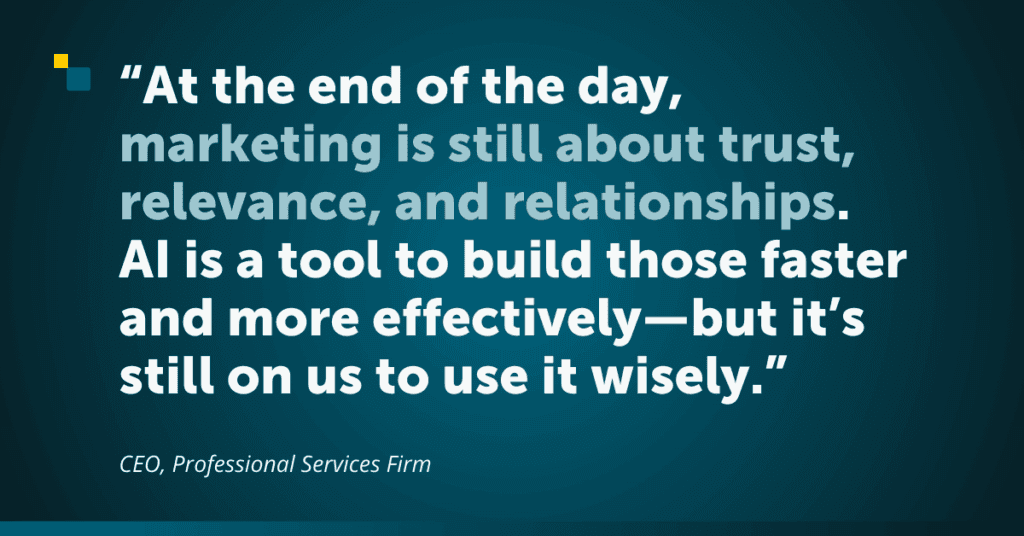
The journey from curiosity to commitment is well underway. Midmarket CEOs are navigating the AI marketing revolution with a blend of enthusiasm and pragmatism, recognizing the transformative potential of AI while remaining grounded in the realities of implementation. They are asking the right questions, conducting thoughtful experiments, and laying the groundwork for a future where AI enhances, rather than replaces, human creativity and strategic thinking.
If you’re a CEO ready to explore how AI can accelerate your marketing strategy—but need the right partner to guide the way—Marketri is here to help. Our fractional marketing model gives you direct access to experienced strategists and specialists who know how to turn innovation into results. Let’s build your roadmap together and make AI work for your business. Reach out to Marketri today to start the conversation.